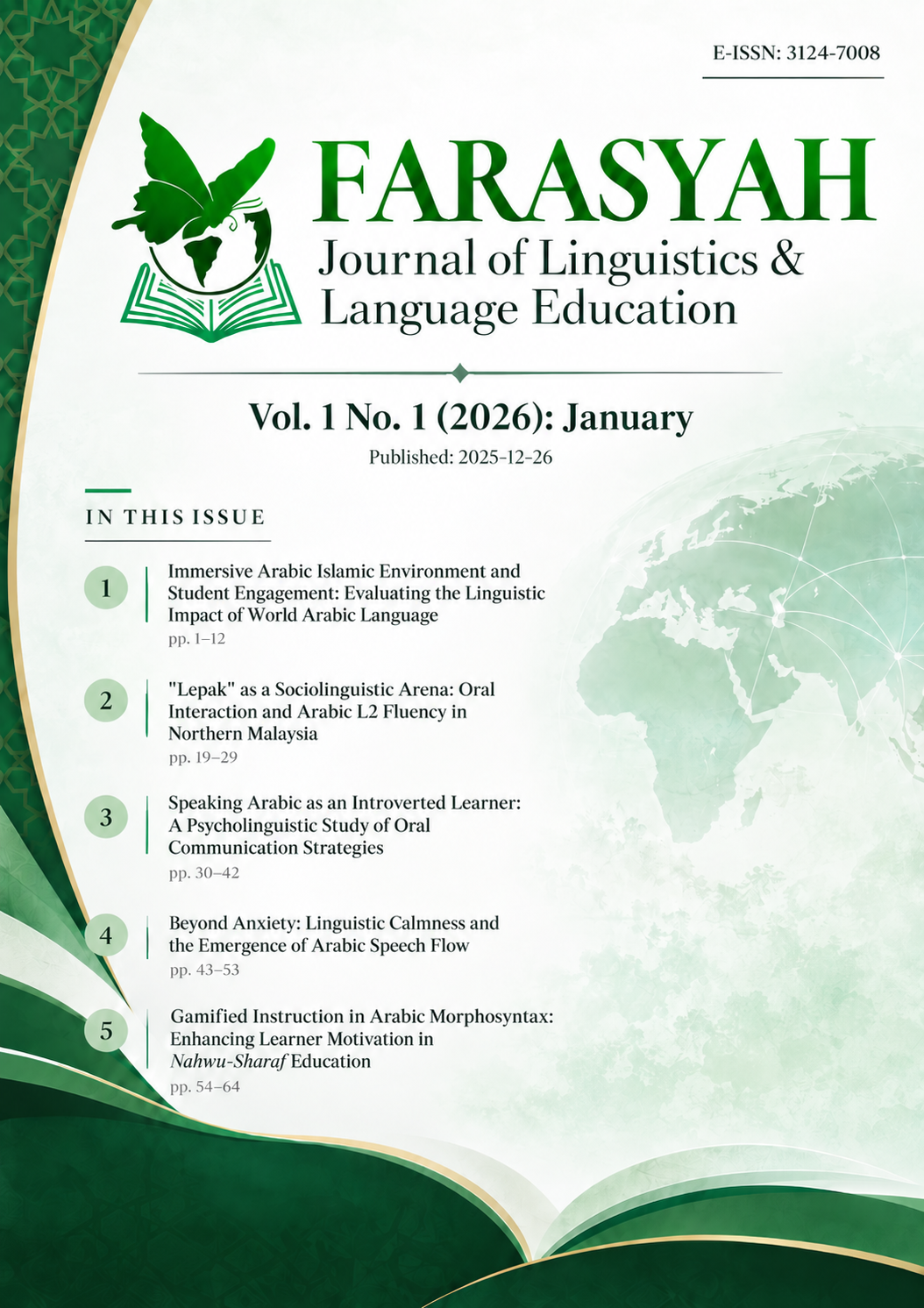
Speaking Arabic as an Introverted Learner: A Psycholinguistic Study of Oral Communication Strategies
DOI:
https://doi.org/10.68299/g6regn37Keywords:
Arabic speaking, Introverted learners, Psycholinguistics, Inner speech, Oral communication strategiesAbstract
Speaking competence (maharah kalām) remains one of the most challenging skills for learners of Arabic as a foreign language, particularly for learners with introverted personality traits. While many introverted learners possess adequate linguistic knowledge, they often struggle to externalize internal language processing into oral communication due to heightened anxiety, cognitive overload, and sensitivity to evaluative pressure. This study aims to explore introverted learners’ experiences of Arabic oral communication through a psycholinguistic lens by examining the effectiveness of gradual, word-by-word speaking strategies. Employing a qualitative descriptive design, the study involved 40 introverted students at a Madrasah Aliyah. Data were collected through classroom observations, audio-recorded paired speaking activities, and semi-structured interviews, and analyzed thematically. The findings indicate that gradual oral production reduces cognitive load, facilitates the transition from inner speech to external articulation, and significantly enhances interactional confidence while lowering speaking anxiety. Rather than forcing spontaneous performance, structured and low-pressure speaking tasks enabled learners to participate more consistently and meaningfully in face-to-face interaction. This study contributes to Arabic language pedagogy by proposing a psycholinguistically grounded, personality-sensitive model of speaking instruction that reconceptualizes oral competence as a staged and inclusive process aligned with introverted learners’ cognitive and affective characteristics.
Downloads
References
Adeoye‐Olatunde, O. A., & Olenik, N. L. (2021). Research and scholarly methods: Semi‐structured interviews. JACCP: JOURNAL OF THE AMERICAN COLLEGE OF CLINICAL PHARMACY, 4(10), 1358–1367. https://doi.org/10.1002/jac5.1441
Balcom, S., Doucet, S., & Dubé, A. (2021). Observation and Institutional Ethnography: Helping Us to See Better. Qualitative Health Research, 31(8), 1534–1541. https://doi.org/10.1177/10497323211015966
Binu, P. M. (2022). The Effect of Online Interaction via Microsoft Teams Private Chat on Enhancing the Communicative Competence of Introverted Students. Arab World English Journal, 13(4), 106–114. https://doi.org/10.24093/awej/vol13no4.8
Campbell, R., Goodman-Williams, R., Feeney, H., & Fehler-Cabral, G. (2020). Assessing Triangulation Across Methodologies, Methods, and Stakeholder Groups: The Joys, Woes, and Politics of Interpreting Convergent and Divergent Data. American Journal of Evaluation, 41(1), Article 1. https://doi.org/10.1177/1098214018804195
Dignath, C., & Veenman, M. V. J. (2021). The Role of Direct Strategy Instruction and Indirect Activation of Self-Regulated Learning—Evidence from Classroom Observation Studies. Educational Psychology Review, 33(2), 489–533. https://doi.org/10.1007/s10648-020-09534-0
Gu, Y., & Sharil, W. N. E. H. (2023). Study on the Effect of Personality Type on the Language Learning Strategies of Non-English Major Students Through MBTI Test. Educational Administration: Theory and Practice, 29(4), 1–19. https://doi.org/10.52152/kuey.v29i4.756
Jiang, D. (2024). A Cognitive Perspective of Language Processing. In D. Jiang, Cognitive Load Theory and Foreign Language Listening Comprehension (pp. 75–96). Springer Nature Singapore. https://doi.org/10.1007/978-981-97-2317-1_6
Khoshnood, A., & Kafipour, R. (2023). The Effect of Mother Tongue Translation on Iranian Extroverted and Introverted EFL Learners’ Vocabulary Learning. Education Research International, 2023, 1–10. https://doi.org/10.1155/2023/2255400
Le, T. T., Nguyen, A. T., Thieu, T. H. Y., Phuong, H. Y., Pham, T. T., Huynh, T. A. T., & Nguyen, H. T. (2023). Unveiling the Linguistic Landscape: The Gendered Impacts on Language Learning Strategies for Introverted Learners. International Journal of Educational Methodology, 9(4), 711–723. https://doi.org/10.12973/ijem.9.4.711
Levelt, W. J. M. (1992). Accessing words in speech production: Stages, processes and representations. Cognition, 42(1–3), 1–22. https://doi.org/10.1016/0010-0277(92)90038-J
Manuhutu, N., Hartono, R., Faridi, A., & Sakhiyya, Z. (2025). Integration of Maluku Local Wisdom “Kalesang” Values through FRESH Technique in Writing Descriptive Text: Introvert and Extrovert Students’ Point of View. Educational Process International Journal, 17(1). https://doi.org/10.22521/edupij.2025.17.303
Mishu, A., Mohammed, H. A., Hakami, S. A. A., & Chowdhury, G. (2023). The impact of online presentations on reducing the introverted EFL learners’ stress and anxiety. Saudi Journal of Language Studies, 3(1), 32–46. https://doi.org/10.1108/SJLS-03-2022-0037
Nggawu, L. O., & Thao, N. T. P. (2023). The impact of Communicative Language Teaching (CLT) Approach on Students’ Speaking Ability in a Public Indonesian University: Comparison between Introverts and Extrovert Groups. International Journal of Language Education, 7(3). https://doi.org/10.26858/ijole.v7i3.50617
Park, S., Carlisle, D. D. E., Cheng, Z., Gillies, M., & Pan, X. (2025). Reducing foreign language anxiety through repeated exposure to a customizable VR public speaking application. Frontiers in Virtual Reality, 6, 1519409. https://doi.org/10.3389/frvir.2025.1519409
Sihombing, P. S. R., Silalahi, D. E., Girsang, S. E. E., Saputra, N., Purba, R., & Sinaga, Y. K. (2023). Identifying the Speech Errors in a Talkshow From a Podcast: A Case on Speech Disfluency. Studies in Media and Communication, 11(5), 18. https://doi.org/10.11114/smc.v11i5.6010
Soliman, R., & Khalil, S. (2024). The teaching of Arabic as a community language in the UK. International Journal of Bilingual Education and Bilingualism, 27(9), 1246–1257. https://doi.org/10.1080/13670050.2022.2063686
Swain, M. (2006). Languaging, Agency and Collaboration in Advanced Second Language Proficiency. In Heidi Byrnes (ed.), Advanced language learning. The contribution of Halliday and Vygotsky (pp. 95–108). Continuum. https://www.cambridge.org/core/product/identifier/S0047404509090484/type/journal_article
Wu, X. M., & Zhang, L. J. (2025). Challenges in Engaging in AfL: Students’ Perspectives. In X. M. Wu & L. J. Zhang, Unveiling Assessment for Learning (Vol. 37, pp. 113–123). Springer Nature Singapore. https://doi.org/10.1007/978-981-95-3529-3_8
Ye, L., Du, J., & He, Z. (2025). Willingness to communicate with AI chatbots in English: The role of personality and trust among Chinese college students. Disability and Rehabilitation: Assistive Technology, 1–16. https://doi.org/10.1080/17483107.2025.2572532
Zhang, L., & Chen, Y. (2021). Examining the Effects of Gamification on Chinese College Students’ Foreign Language Anxiety: A Preliminary Exploration. 2021 4th International Conference on Big Data and Education, 1–5. https://doi.org/10.1145/3451400.3451401
Downloads
Published
Issue
Section
License
Copyright (c) 2025 Samsul Huda, Adham Hasif bin Najmuddin Najmuddin, Muhammad Nizar (Author)

This work is licensed under a Creative Commons Attribution-ShareAlike 4.0 International License.