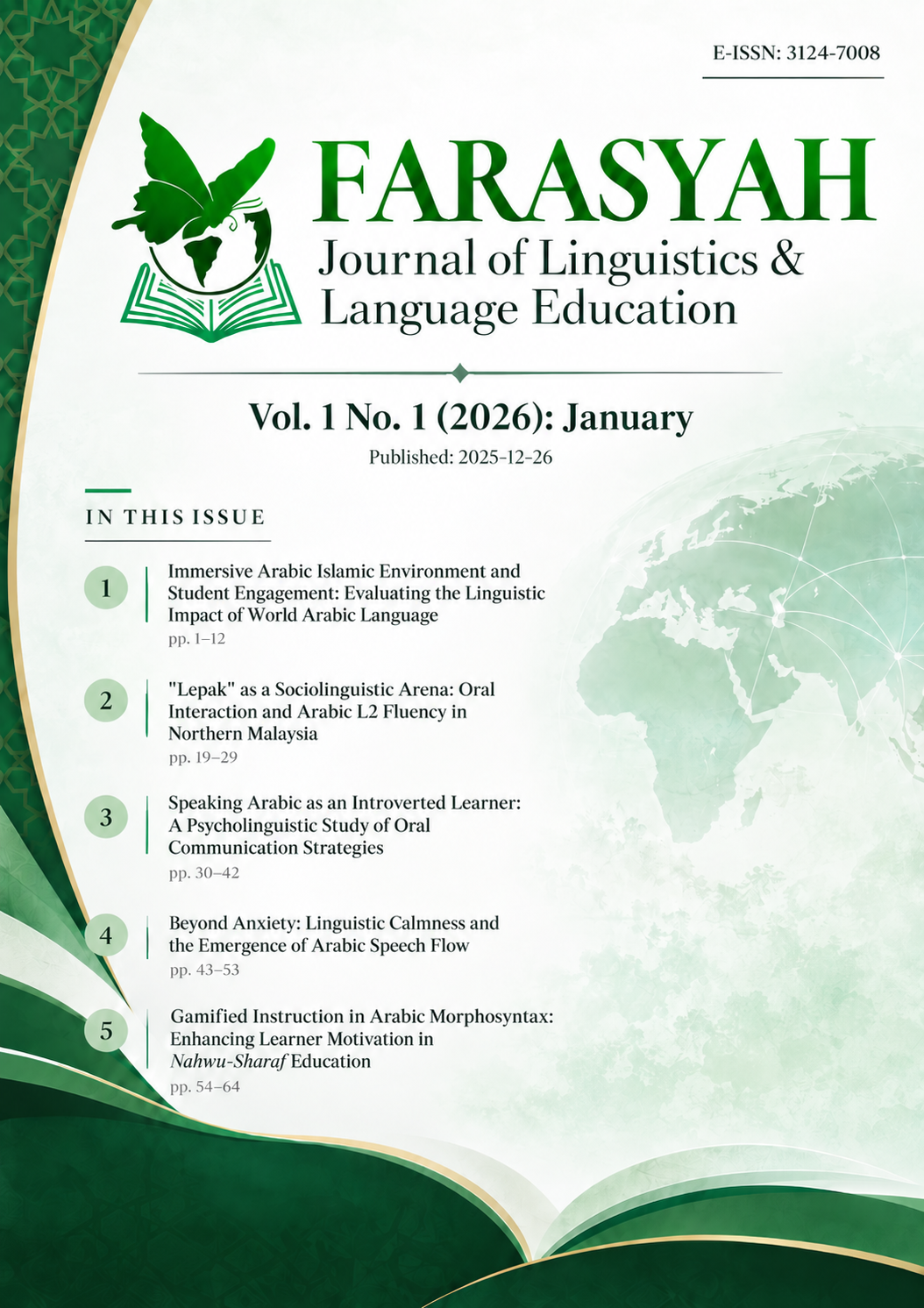
Beyond Anxiety: Linguistic Calmness and the Emergence of Arabic Speech Flow
DOI:
https://doi.org/10.68299/79946j59Keywords:
Linguistic Calmness, Arabic Speech Flow, Second Language Speaking, Affective Factors, Willingness to CommunicateAbstract
Second language (L2) speaking has frequently been examined through the lens of anxiety, particularly in Arabic language education where strong normative expectations and accuracy-oriented practices often constrain oral interaction. However, anxiety-centered approaches offer limited insight into how fluent speech actually emerges during real communicative engagement. This study shifts the analytical focus from anxiety reduction to the emergence of Arabic speech flow under conditions of linguistic calmness. Linguistic calmness is conceptualized as an enabling affective state characterized by emotional stability, perceived communicative safety, and reduced self-monitoring. Employing a qualitative-dominant mixed-methods design, the study involved 40 Arabic learners in Malaysia and drew on classroom observations, audio-recorded speaking activities, and semi-structured interviews. The findings indicate that linguistic calmness emerges dynamically through interaction rather than preceding it, enabling learners to sustain oral production despite linguistic limitations. Speech flow was found to manifest as interactional continuity and communicative momentum rather than accuracy-driven performance. The study contributes theoretically by introducing linguistic calmness as a distinct affective construct that complements existing frameworks on willingness to communicate and fluency. Pedagogically, it highlights the importance of designing emotionally supportive speaking environments that facilitate natural and sustained Arabic oral interaction.
Downloads
References
Adeoye‐Olatunde, O. A., & Olenik, N. L. (2021). Research and scholarly methods: Semi‐structured interviews. JACCP: JOURNAL OF THE AMERICAN COLLEGE OF CLINICAL PHARMACY, 4(10), 1358–1367. https://doi.org/10.1002/jac5.1441
Ali, Z., Palpanadan, S. T., Asad, M. M., Churi, P., & Namaziandost, E. (2022). Reading approaches practiced in EFL classrooms: A narrative review and research agenda. Asian-Pacific Journal of Second and Foreign Language Education, 7(1), 28. https://doi.org/10.1186/s40862-022-00155-4
Creswell, J. W. (2021). A Concise Introduction to Mixed Methods Research. SAGE Publications, Inc.
Creswell, J. W. (2024). My 35 Years in Mixed Methods Research. Journal of Mixed Methods Research, 18(3), 203–215. https://doi.org/10.1177/15586898241253892
Dignath, C., & Veenman, M. V. J. (2021). The Role of Direct Strategy Instruction and Indirect Activation of Self-Regulated Learning—Evidence from Classroom Observation Studies. Educational Psychology Review, 33(2), 489–533. https://doi.org/10.1007/s10648-020-09534-0
Guo, Y., Wang, Y., & Ortega-Martín, J. L. (2023). The impact of blended learning-based scaffolding techniques on learners’ self-efficacy and willingness to communicate. Porta Linguarum Revista Interuniversitaria de Didáctica de Las Lenguas Extranjeras, 40, 253–273. https://doi.org/10.30827/portalin.vi40.27061
Li, C., Dewaele, J.-M., Pawlak, M., & Kruk, M. (2025). Classroom environment and willingness to communicate in English: The mediating role of emotions experienced by university students in China. Language Teaching Research, 29(5), 2140–2160. https://doi.org/10.1177/13621688221111623
Shaalan, D. (2023). Role of Learning Environment in Arabic as a Foreign Language in Saudi Arabia. Theory and Practice in Language Studies, 13(9), 2186–2194. https://doi.org/10.17507/tpls.1309.04
Tibi, S., Edwards, A. A., Kirby, J. R., & Salha, S. H. (2024). Reading Anxiety in Arabic University Students. SAGE Open, 14(4), 21582440241295661. https://doi.org/10.1177/21582440241295661
Zadorozhnyy, A., & Lee, J. S. (2025). Informal Digital Learning of English and willingness to communicate in a second language: Self-efficacy beliefs as a mediator. Computer Assisted Language Learning, 38(4), 669–689. https://doi.org/10.1080/09588221.2023.2215279
Downloads
Published
Issue
Section
License
Copyright (c) 2025 Syarif Muhammad Syaheed, Ahmad Azkia Salam (Author)

This work is licensed under a Creative Commons Attribution-ShareAlike 4.0 International License.